Men's Hair Color: Natural-Looking Gray Coverage That Works
Oct 05,2025
Listen, I'm going to be straight with you, right here, right now. Twenty years ago, if someone had told me that we would be having a candid discussion about men's hair color, I would have said they were delusional. But you know what? It has changed. And the men who are winning - looking youthful, vibrant and proud - know something that is very important: Looking your best is not about vanity. Let us discuss respect. Respect yourself, respect others, and respect the moment each day provides you with the opportunity to live your life.
So you've been catching reflections of yourself in the mirror lately. Maybe you are noticing more and more gray hair peeking around your temple area? Maybe your natural color has become so faded that you appear washed out and exhausted, even when you feel fantastic! And, here is what I already know about you - you do not want to look like you dunked your head in a bucket of shoe polish. You want natural-looking hair color. You want people to think of you and say: "Wow, he looks great" instead of: "Wow, he colored his hair".
Understanding Gray Hair: The Science Behind the Change
Beneath your visible strands, your hair follicles contain specialized cells - which are also called melanocytes. These hair factories create two kinds of melanin: eumelanin - which generates brown and black pigments and pheomelanin - which generates red and yellow pigments. It is the ratio of these two special kinds of melanin through dysregulation, that determines the color of your hair.
To start with, here's a fun fact! Starting somewhere in your mid-thirty's - I am going to skip genetics, since they have the primary role! Your melanocytes have begin to slow down your hair making process. They are like workers who are heading out early. Some studies from the University of Bradford have found a build up of hydrogen peroxide in hair follicles when we age causing a bleaching from the inside out. Your body naturally produces an enzyme called catalase, which breaks down hydrogen peroxide, but as we age, levels of catalase decrease, and gray hair begins to appear in place of the pigmentation.
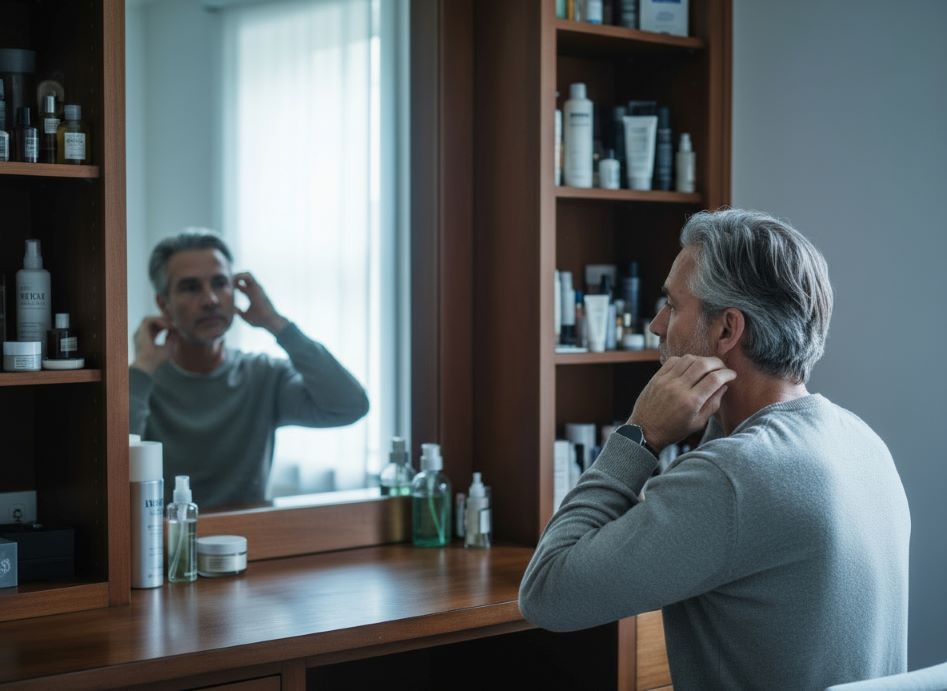
And here's the kicker: stress speeds that process up. A 2020 study from Harvard found that stress activates the sympathetic nervous system (your fight-or-flight response), which depletes melanocyte stem cells in hair follicles. In other words, when people say stress turned their hair gray, they may not be lying. Science backs them up.
Why Natural-Looking Hair Color Matters
I've coached C.E.O.'s of Fortune 500 companies, pro athletes, and everyday folks, just trying to show up as the best version of themselves. And here's what distinguishes the guys with hair color that looks good from the guys who don't. They get that the goal is not to look 25 again—it is to look like the most vital and energetic version of yourself, at whatever age you are now.
Your brain processes faces at lightning-fast speed: 100 milliseconds. Studies from Princeton University show people make judgments about competence, trustworthiness, and dominance in that small window of time. This is exactly why first impressions matter so much.
When your hair color looks unnatural or different, you trigger an unconscious alarm in people, producing the thought 'there is something off here.' No one wants to come across that way to a boardroom, on a first date, or during a job interview!
The solution? A subtle, gradual approach to enhance your hair color that works with the rest of your natural colors, versus against it. Think of this as you are not painting over a masterpiece.
Matching Hair Color to Your Skin Tone
Before you ever move forward, you first must understand your natural base color and tone. This is not optional, believe me; this is the difference between looking refreshed, or utterly ridiculous.
Your skin tone is warm, cool, or neutral.
Warm skin tones have golden, peachy, or yellow undertones. Cool skin tones tend to have pinky, red, or blue undertones. Neutral tones are between the two. The fastest way to determine your skin tone matching at home is to look at the veins in the inside of your wrist while in natural light. If your veins appear to be green, you have warm undertones, blue or purple veins are dedicated to cool, and mixed color veins would be neutral.
Why is this so important? When a hair color does not match your skin tone, you will never achieve a natural look, regardless of the money spent and skill of the hair colorist in the salon. A man with warm skin tones will always look more natural with golden browns, chestnut colors, or warm black colors.
Your eye color is also a very important indicator. Brown eyes can generally get away with more shade choices. Blue and green eyes generally look best with colors that are no more than two shades darker than the natural color because if a person goes two or three shades darker than their original color, the hue can become harsh and cause a stark contrast that draws the eye to the obvious contradiction.
The Gradual Approach to Men's Hair Color
Let me share something I learned from a top colorist in Beverly Hills who collaborates with actors and actresses for roles. He said to me, "The moment everyone recognizes something is the moment we failed." That changed the way I think about enhancement.
The products that reduce gray and change the hair color over the course of two to three weeks become your friend. It works to deposit small amounts of dye every time you use the product. You are not shocking your appearance overnight! Your coworkers will not gather around the water cooler fighting to figure out what has changed. Your family will not look twice when you sit down to dinner. Everyone's going to think, "Wow, you look rested; you look healthy; you look energetic!"
These types of products will typically have metallic salts or even oxidative dyes in lower concentrations, which build color; Therefore small amounts of metallic salts deposit with each application. The chemistry is typically smaller molecular sizes that penetrate the hair shaft in small amounts instead of at once. Brands such as Just For Men Control GX work the same way–every shower you use you will deposit a little bit more color, and once you have obtained the color you desired, you just maintain the color with the color depositing system.
Semi-Permanent vs Permanent: Choosing Your Hair Dye Type
The semi-permanent color will coat the hair shaft and not penetrate deeply because semi-permanent colors do not operate at the cortex. The product typically lasts for 6-12 shampoos and will fade gradually. As for semipermanent dyes, the molecules are larger and cannot penetrate but the semipermanent dyes are flexible. If you want to test out hair color without a long-term commitment, this is your option.
Permanent color involves using ammonia to raise the hair cuticle and hydrogen peroxide to break down the natural color and deposit a new color. This means a chemical change occurs, which isn't washed out; that's the good news. The bad news is that you're committed to it, and as your hair grows, you'll need consistent touch-ups at the root.
The demi-permanent color choice is in the middle. It uses a low-volume peroxide developer and doesn't contain ammonia. It partially penetrates the hair shaft and will wash out after about 24 shampoos. It also can effectively cover gray since the color is only partial, which doesn't create a harsh line of demarcation like permanent. For most men exploring hair color, demi-permanent is a great balance of effectiveness and manageability.
Hair Color Application Methods for Natural Results
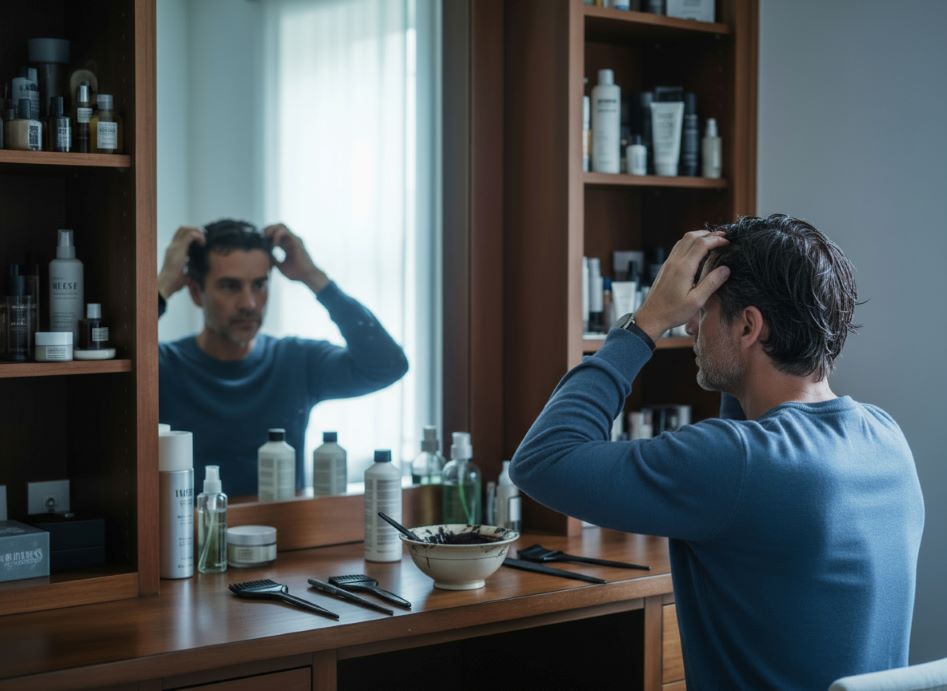
Professional colorists know something that most guys don't. The application method is sometimes more important than the actual color! Just laying a single-process color all over your head feels like rookie hour. Natural hair has variation. It has dimension. Different areas of the head catch light differently, making the hair come alive; uniform color applied is now flat and straining.
Targeted application is your secret sauce. Do you only want to color the gray at your temples? Apply color only to those sections. Sparse coverage throughout? Use the blending application method where you don't saturate every strand. I have seen some guys pull off great looks while leaving 20-30% gray, especially if it's in flattering locations like the temples or mixed throughout. This yields what professionals refer to as "salt and pepper sophistication."
However, timing is important. For instance, it will say to leave it on for X minutes, but your hair's porosity (or absorbency) will vary based on your own genetic makeup, different chemical treatments you've had prior and even the water at your location. You shouldn't rush it. Regardless, you can always add more next time, but you can't retrieve any color once your hair absorbs it.
Maintaining Your Hair Color: What to Expect
Here's the bomb you won't see in most of the articles: maintenance is where many guys fail. On average, hair grows approximately half an inch per month. If you went darker than your natural color, you will begin to see a visible root line in 3-4 weeks, and this requires maintenance on a regimen. Not only does this require time, but also money and commitment.
This is where professional solutions come into play. For example, a competent barber or colorist can apply color to your new growth every 4-6 weeks, which is faster and less costly than a full application. Some salons have found a niche service for men's color services, so the wearer understands, you want your services efficient and effective, not being in the chair for sometimes two hours discussing the week's events. A root touch-up is often the most practical solution.
In between visits, color-depositing shampoos and conditioners can help. Color-depositing shampoos and conditioners will have small amounts of deposited color, which will help extend your color results with each wash. Purple shampoo will neutralize unwanted warming tone that develops with gray or white hair. Blue will neutralize unwanted brassy or orange tones for darker colors. Learn more about strategies to keep your hair color intact.
Lifestyle Factors That Affect Hair Color
Your habits play a role on how your color continues to hold its integrity. Chlorine from a swimming pool is brutal and will not only strip color, but may also add green or brassy tones. Minerals in heavy water from your shower can change the chemistry of color over time. You will be surprised how fast UV could have an impact on color fading, with studies suggesting that one summer, sun tan alone, will fade hair color up to 40%.
With that said, there are strategies to protect your investment. A cap in the pool is not just for grandma's. You should consider a clarifying shampoo every week for mineral buildup. And, consider UV protectant hair care products to create a barrier. These little, small habits, will help extend your investment in your color exponentially.
Your diet affects your hair and hair color, but not in the way you may think. For healthy hair growth and hair structure, consuming protein is important, as healthy hair accepts and holds color better. B vitamins, and specifically B12, help in melanin production. Color will not reverse your gray hair, but it helps create healthy hair overall, which can help the application of color to your hair. If you're also concerned about thinning, check out our guide on tips for receding hairline.
When to See a Professional Colorist
Look, I'm all about personal power and owning your life. But there are times when you need expertise. If you're making a drastic change to your hair—going from fully grayed to brown or light to dark—go to a professional. The color correction horror stories I've heard from the male clients I've gotten who just wanted to save a little money and tried to DIY a drastic change would make you squirm. If you have more than 50% gray, blending techniques that you can only get with a professional are something box color cannot deliver. A skilled colorist can create multi-dimensional color with two to three shades that mimic blessed natural hair of reflecting naturally in the light. They will be able to assess the condition of your hair, let you know what to expect colorantly, and offer corrective treatment methods that your original hair color will effectively be preserved and maintain its integrity.
Red flags that it would be time to finding a good professional: you're using box color and look at your hair and see that it's different areas have different even color from the prior DIY repairs, you want to FIX the green or orange that you just can't get back to your original, you've done something really bad to your hair or it's hair that you need a professional help because you simply can't visualize the right shade for your coloring. I would argue that the consult is worth the price because you'll learn specifically what will work for the current situation that your in.
The Confidence Factor: Looking Your Best
Honestly, this is the reason we're even having this discussion or this at all.
Take away all of the technical info, and let's rest on one question–why is this important? Because when you go into the bathroom and you look in the mirror and see someone who looks tired, like they are 20 years older than what they feel, or see someone you just simply don't see yourself as? It effects everything. Your energy. Your presence. Your will to show up for your life and allow others to witness you.
I've seen the only reason men can make huge changes in their jobs, relationships, and self-perceptions is by making some simple tweaks with there look. And it wasn't they were looking younger that was the solution, it was more that they simply stopped letting their look or the way that they felt about their appearance, holding them back from showing up fully in their lives. Discover more about what signals confidence in your appearance.
You deserve to look the best version of you for the rest of the world to see. Not the fake version. Or I'm trying too hard version. Or, here please don't notice me version. You and the time you put in to enhance and reflect your authentic look. Hair color may feel superficial until you truly understand the psychological and social research that had found, people who feel good about their appearance take more risks, bigger opportunities, and show up more readily to life.
You're not chasing youth here. You're refusing your biology define how vital and energetic you look when you're feeling the opposite inside. You're finding alignment—by exhibiting the outside presentation that matches the reality of what you are feeling on the inside.
So if you have been curious and wondering while wanting attempt, just know that the best time to start was yesterday. The second best time is right now. Do your research, start slow, and keep in mind that it is just enhancement of a naturally looking to you and there is an art form in this. Once you get this down, you will have one of the most powerful tools that you'll ever have in the daily prep and showing up as the best version of yourself.
Kommentar